Quick answer
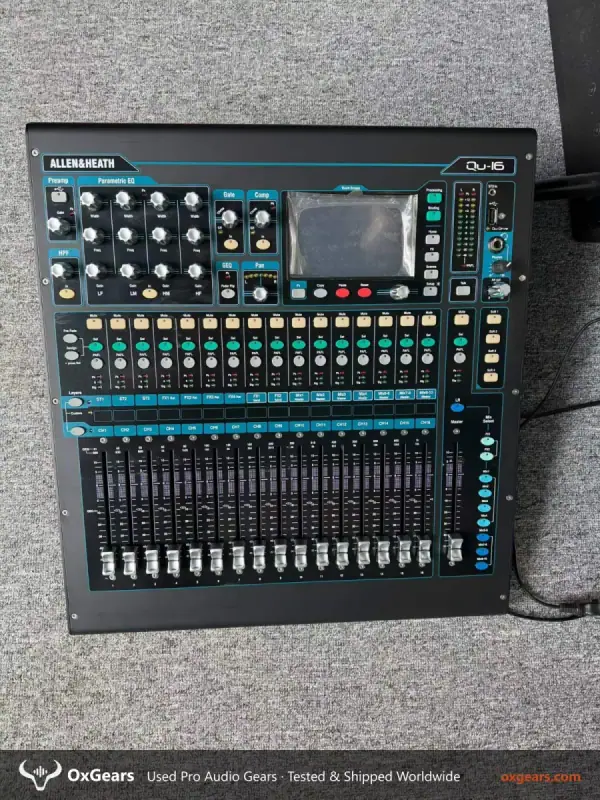
The listing offers a used Allen & Heath QU-16 mixing console graded A, with 16 channels, 16 faders, 48 kHz operation, a touch screen and USB, XLR, TRS, ST3, phones and all-out connectivity. For a distributor, rental company or venue buyer it is a compact digital console candidate, but the listing does not disclose serial history, service records, actual hours, price or year of manufacture, so the decision rests on verifying the unit before payment. Ask for availability and a quote through the product page and confirm the open items first.
Key takeaways
1. The listing confirms 16 channels, 16 faders, 48 kHz, touchscreen control and a broad I/O set, which defines the deployment envelope.
2. Grade A is a condition grade only; it does not replace a serial check, service history or a functional test of faders and touchscreen.
3. At 483 × 210 × 57 mm and 4.5 kg the console is compact and light, which matters for rental transport and small control positions.
4. Price, warranty, lead time, MOQ, year of manufacture and quantity are not disclosed, so none of them should be assumed.
What the listing data says
The listing states the unit is an Allen & Heath QU-16 in the mixing-consoles category, condition grade A. The published specs are 16 channels, 16 faders, 48 kHz sample rate, inputs and outputs covering USB, XLR, TRS, ST3 in, phones and all out, Ethernet via the QU-Drive port, control by touch screen, encoder and buttons, a touch screen display, dimensions of 483 × 210 × 57 mm and a weight of 4.5 kg. Year of manufacture and quantity available are both listed as on request.
Two things follow from that combination that a generic product page will not spell out. First, 16 channels matched to 16 faders means one fader per channel in the default layout, so a buyer planning to layer inputs across fader banks should confirm how the console is configured in practice rather than assume extra headroom. Second, the 483 mm width is a standard 19-inch rack width, which makes the unit a candidate for rack-mounted or fixed install positions as well as a small FOH desk; the 4.5 kg weight keeps transport and shipping simple, which is relevant for export buyers comparing freight per unit.
The Ethernet connection is described as running via the QU-Drive port, which is a specific detail worth reading carefully: it tells you the network path is tied to that port rather than a separate dedicated network socket, so cabling and port allocation should be planned around it. The I/O list is broad for a console of this size, covering USB, XLR, TRS, an ST3 input, phones and all out, which suits small rental and venue jobs where a mix of microphone, line and playback sources is normal.
Grade A is the other listing fact. On OxGears, grading describes condition, and the site already explains how used professional audio is graded A, B and C. Grade A tells you the unit is at the top of the condition scale as graded, but it does not tell you the serial number, the service history, the hours run or whether the touchscreen and motor faders have been calibrated. Those are separate questions and they belong in the pre-payment check.
What the datasheet does not tell you
The biggest gap is history. The listing does not disclose the serial number, so a buyer cannot trace the unit's origin, age or prior use. Year of manufacture is on request, which means the age of the console is unknown at the point of reading. Service and repair records are not disclosed, so there is no documented evidence of past faults, fader replacement or board-level work. Actual operating hours are not stated, and for a digital console with a touchscreen and motor faders, hours and environment matter because they drive wear on moving parts and the display.
Physical condition detail is also missing. The listing does not describe the flight case or packaging, so a buyer cannot judge how the unit has been transported or how it will arrive. Cosmetic condition beyond the grade is not itemised. Quantity available is on request, which affects whether this is a single-unit purchase or a batch opportunity for a distributor. Price, warranty, lead time and MOQ are not disclosed anywhere in the materials, so any figure quoted in negotiation should be treated as new information, not an assumption.
Why this matters for the decision: a Grade A label is a starting point, not a substitute for a serial check and a functional test. If the console is going into a rental fleet, undocumented history raises the risk of a fader or touchscreen fault appearing after delivery, and without a stated warranty the cost of that fault falls on the buyer. If it is going into a fixed venue install, the risk is downtime during an event. Either way, the unknowns are the reason to ask questions before paying rather than after.
Who should not choose this
Do not choose this unit if your room or production needs more than 16 channels or more than 16 faders. A venue running a full band plus playback, or a rental company servicing larger stages, will run out of capacity quickly, and the console's compact format is a strength only where the channel count fits. Buyers who need more faders than the 16-channel ceiling here should also compare this unit against a used Yamaha DM1000 before deciding which frame suits their rental fleet.
Do not choose it if you require documented service history, a known year of manufacture or a stated warranty before committing budget. None of those are in the materials, and a buyer whose procurement rules demand them should either request them explicitly or look elsewhere.
Do not choose it if you need a console with a dedicated network socket rather than Ethernet via the QU-Drive port, or if your workflow depends on a control surface layout beyond touchscreen, encoder and buttons. And do not choose it as a primary console for a large fixed install where a bigger frame and more faders are the norm; this is a compact 16-channel desk, and treating it as anything more is a mismatch.
Trade-offs to weigh
The trade-off between portability and capacity is the central one. At 483 × 210 × 57 mm and 4.5 kg the QU-16 is easy to move, ship and rack, which lowers freight cost per unit for export orders and makes it practical for small venues and mobile rental jobs. The cost of that portability is the 16-channel, 16-fader ceiling; buyers who occasionally need more inputs will find the limit binding, and the workaround is a second console or a larger model, not a configuration change. For a fixed install in a small private room, a compact 16-channel desk like this fits the same footprint as a KTV sound system rack, so confirm the rack width and cabling before committing.
The trade-off between touchscreen control and physical wear is the second. The listing specifies a touchscreen display plus encoder and buttons, which is a modern control layout, but a used touchscreen is a wear item and its condition is not documented. A buyer weighing a Grade A unit should treat the screen and the faders as the two components most likely to need attention, and should price that risk into the offer rather than assume the grade covers it.
The trade-off between grade and documentation is the third. Grade A gives a condition signal that is useful for sorting inventory, but it does not replace a serial number, service record or functional test. Buyers who need documentation should ask for it; buyers who accept the grade as-is should still verify the unit's basic functions before payment. The listing's silence on price, warranty, lead time and MOQ means the commercial terms are open, and the buyer who asks first gets the clearer picture.
Finally, weigh the I/O set against your actual patch. USB, XLR, TRS, ST3 in, phones and all out cover a lot of small-venue and rental scenarios, but the Ethernet-via-QU-Drive-port detail means network planning should be confirmed against your existing cabling. If your workflow depends on a separate network port, this is a constraint to check, not a detail to skip.
Next step before you pay
Ask for availability and a quote for this specific unit through the contact page, and request the serial number, year of manufacture, service records and quantity available in the same message. Ask for photographs of the touchscreen, faders and rear panel, and for confirmation of what is included in the sale, including flight case or packaging. Confirm the commercial terms in writing: price, warranty if any, lead time and MOQ are all undisclosed in the listing, so they must come from the seller rather than from assumption.
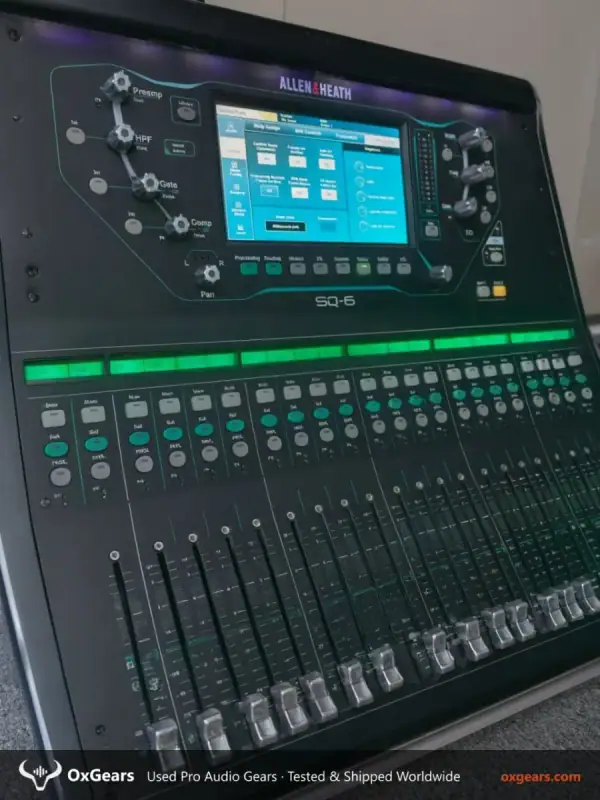
Before paying, arrange a functional check covering power-up, touchscreen response, fader movement across all 16 faders, and the listed I/O including USB, XLR, TRS, ST3 in, phones and all out. Confirm the Ethernet path via the QU-Drive port works as described. If you are buying for a rental fleet, compare this unit against other options in the mixing consoles category and against the site's existing guide to a used Allen & Heath SQ-6 to see whether a different model fits your channel count better. Buyers sourcing multiple items can also review second hand line array speakers and other categories in the same shipment to spread freight.
FAQ
What condition is this used Allen & Heath QU-16 in?
The listing grades it A. Grading describes condition as assessed; the listing does not itemise cosmetic detail, serial history or service records.
How many channels and faders does the QU-16 have?
The listing states 16 channels and 16 faders, with a 48 kHz sample rate and a touchscreen display.
What inputs and outputs are listed?
USB, XLR, TRS, ST3 in, phones and all out, with Ethernet via the QU-Drive port and control by touch screen, encoder and buttons.
Is the price, warranty or lead time included?
No. Price, warranty, lead time, MOQ, year of manufacture and quantity available are not disclosed in the materials and must be requested from the seller.
What should I check before paying?
Request the serial number, year of manufacture, service records and photos, then confirm power-up, touchscreen response, all 16 faders and the listed I/O, including the Ethernet path via the QU-Drive port.
## Sources
OxGears listing: Allen & Heath QU-16 — /products/allen-heath-qu-16/
Manufacturer published specifications for Allen & Heath QU-16 — no verifiable URL supplied.
Not sure this unit fits your rig? Talk to our technical team before you buy.