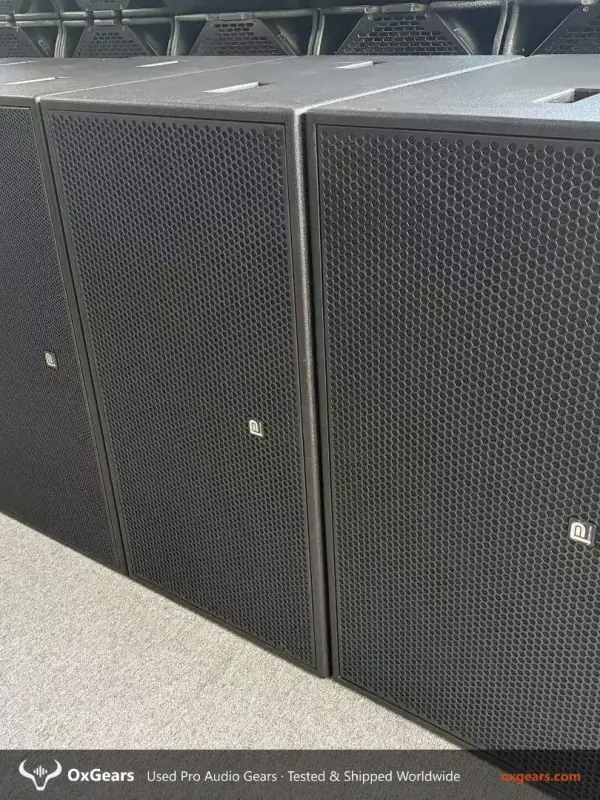
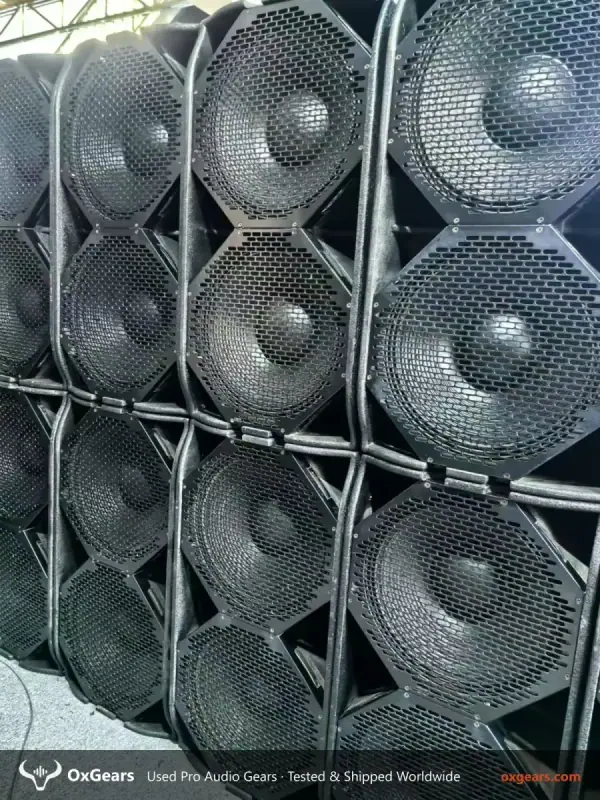
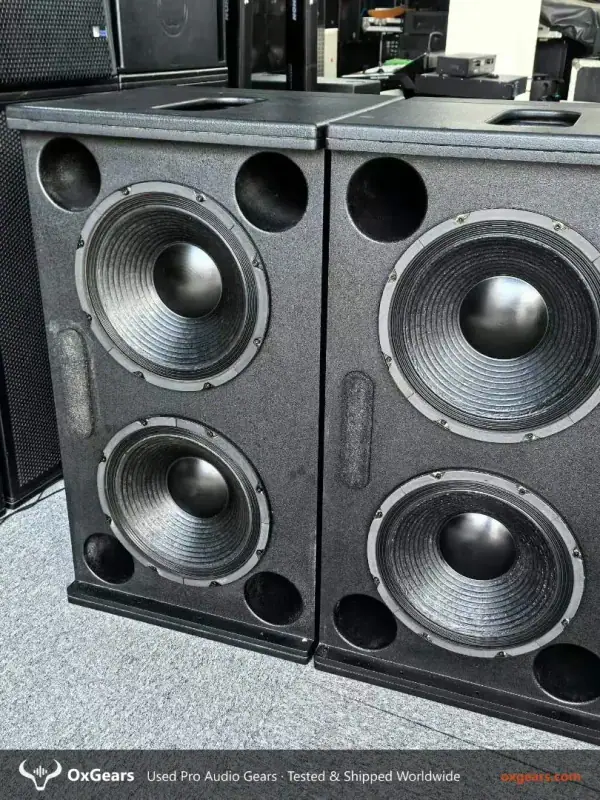
The used RCF L18S801 is a passive single-18 subwoofer rated 1400 Watt PGM / 700 Watt AES at 8 Ohm, covering 38 Hz to 1.0 kHz with a stated 136 dB max SPL, offered here in Grade A condition. If you are buying for a rental fleet or a fixed install, the decision comes down to whether you can supply and process the amplification yourself, because this cabinet ships without one. Ask OxGears for current availability and a quote before you plan around it.
Quick answer
The RCF L18S801 is a passive 18 inch subwoofer that needs an external amplifier and DSP, so it suits rental companies and integrators who already own amplification rather than buyers who want a self-powered box. Grade A condition is the strongest cosmetic and functional grade in the OxGears scale, but the listing does not disclose year of manufacture, quantity or driver service history, so those must be confirmed before payment.
Key takeaways
1. The cabinet is passive with no amplifier, so budget for an external amp delivering 700 Watt AES into 8 Ohm per box.
2. Its 38 Hz to 1.0 kHz range and 136 dB max SPL make it a general-purpose subwoofer rather than a deep sub extension cabinet.
3. Grade A tells you the unit passes grading for condition, not that the driver has never been re-coned.
4. Year of manufacture and quantity are listed as on request, so confirm both before committing to a fleet order.
What the listing data says
The listing describes a single 18 inch driver in a cabinet measuring 590 x 590 x 720 mm and weighing 48 kg, with two NL4 connectors, 8 Ohm nominal impedance, 1400 Watt PGM and 700 Watt AES power handling, a 38 Hz to 1.0 kHz frequency range and 136 dB maximum SPL. Condition grade is A. Year of manufacture and quantity available are both marked on request. For fixed installs where the 38 Hz floor is acceptable, a club sound system built around passive subs and external amplification is a realistic fit.
Read together, those numbers describe a compact, moderately heavy subwoofer built for stacking and ground deployment. At 590 mm across and 720 mm deep it is a near-cube, which is the shape rental companies like because it stacks predictably and pairs with pole-mounted full-range boxes. The 48 kg weight is manageable for two people and keeps transport costs sane on export pallets.
The 8 Ohm impedance is the detail that shapes the amplifier decision. Two cabinets in parallel present 4 Ohm, which is a common and comfortable load for most touring amplifiers, so a pair per amp channel is realistic. The 700 Watt AES figure is the continuous thermal rating; the 1400 Watt PGM figure is the program rating and should not be read as a target amplifier size on its own.
The 38 Hz lower limit is honest for a compact 18 inch box but it is not sub-extension territory. If your programme material depends on content below 38 Hz, this cabinet will not deliver it, and no amount of amplifier power changes that. The 1.0 kHz upper limit is unusually high for a subwoofer and suggests the box can be crossed higher than typical, which matters if you plan to pair it with small full-range cabinets that run out of low-mid output early.
The two NL4 connectors are the standard speakON pattern, so cabling is not a sourcing problem. If you are building a fleet, browse the wider used pro audio equipment range to check amplifier and processor availability alongside the cabinets.
What the datasheet does not tell you
The listing gives no year of manufacture. For a passive subwoofer that matters less than for a digital console, but it still affects resale value, spare-part availability and how the cabinet has aged. Ask for it.
Quantity available is also on request. That is the single most important number for a distributor or rental house, because a fleet decision depends on whether you can standardise on one model across multiple venues or tours. A single unit is a spot purchase; ten units is a fleet decision with different commercial terms.
There is no statement about driver originality, re-cone history or whether the 18 inch driver is the original RCF part. A re-coned driver is not automatically a problem, but it changes what the cabinet is worth and how you should test it. The re-coned driver explainer is worth reading before you assume a Grade A cabinet has an untouched driver.
There is no measurement data: no impedance sweep, no SPL curve, no rub-and-tickle test result. Grade A is a condition grade assigned by the seller, not a laboratory report. That is normal for used pro audio, but it means your own incoming inspection carries the risk.
No price, warranty, lead time or MOQ appears in the listing. Those are commercial terms to be quoted, not published facts, and any figure you see elsewhere should be treated as unverified until OxGears confirms it in writing.
Who should not choose this
Do not choose this cabinet if you need a self-powered subwoofer. There is no amplifier inside, so a buyer without amplification, cabling and processing is buying a box that cannot make sound on its own.
Do not choose it if you need genuine sub-extension below 38 Hz for dance music or cinema-style low end. The published range stops at 38 Hz, and that is a design limit, not a tuning option. Rental companies standardising on this cabinet should also check the wider used pro audio equipment range for matching amplifiers and processors.
Do not choose it if you cannot document the service history you require. If your procurement rules demand a known year of manufacture and a driver provenance record before purchase, this listing does not supply either as standard, and you should treat that as a disqualifier until OxGears answers.
Do not choose it if you are buying for a single small venue with no amplifier inventory and no one to set crossover and limiting. A passive subwoofer without processing is a support call waiting to happen.
Trade-offs to weigh
Passive versus active is the first trade-off. Passive cabinets are cheaper to buy, easier to repair and let you standardise on one amplifier platform across a fleet. They also push the amplifier, cabling and DSP cost onto you, and they make the system only as good as the processing behind it.
Compact versus deep is the second. A 590 x 590 x 720 mm box at 48 kg is easy to move and stack, and it will fit venues and trucks that a larger subwoofer will not. The price of that convenience is the 38 Hz floor.
Single 18 inch versus multi-driver is the third. One driver per cabinet gives you granular scaling: two boxes for a small room, eight for a club. It also means more cabinets, more cable runs and more amp channels for the same output compared with double-18 designs.
Grade A versus documented history is the fourth. Grade A is the best condition band available here, and it should reduce your inspection risk. It does not replace a driver history, and it does not tell you the year of manufacture. Weigh the grade as a starting point, not a conclusion. Buyers who need deeper low end than the 38 Hz floor should compare this cabinet against a used Funktion One 21SW152 subwoofer before committing to the L18S801.
Finally, weigh the 1.0 kHz upper limit. It gives you crossover flexibility, but it also means the cabinet can be asked to reproduce low-mid content that a purpose-built subwoofer would not. Set your crossover deliberately rather than exploiting the full range.
Next step before you pay
Ask OxGears for availability, quantity, year of manufacture and a quote through the contact page. Put the questions in writing so the answers are on record: how many units are available, what the year of manufacture is, whether the drivers are original or re-coned, and what the condition grade covers.
Then plan your own incoming inspection. On arrival, check both NL4 connectors for continuity and mechanical damage, confirm the driver moves freely without rubbing, and verify the cabinet joints and grille. Run a low-frequency sweep at modest level and listen for rattles and air leaks. Confirm the impedance with a meter before connecting to a touring amplifier.
Match amplification to the 700 Watt AES rating at 8 Ohm and set limiting before the first show. Do not size the amplifier from the 1400 Watt PGM figure alone.
If you are buying multiple cabinets, confirm the quantity before you commit to a standard model across a fleet, and check the RCF L18S801 product information for the specification set you will quote internally.
FAQ
Is the RCF L18S801 an active or passive subwoofer?
It is passive. The listing shows amplifier as N/A, so the cabinet needs an external amplifier and processing.
What amplifier power does the RCF L18S801 need?
The listing gives 700 Watt AES continuous and 1400 Watt PGM program handling at 8 Ohm. Size the amplifier to the AES figure and set limiting accordingly.
How low does the RCF L18S801 go?
The published frequency range is 38 Hz to 1.0 kHz, so it does not extend below 38 Hz.
What condition is this used RCF L18S801 in?
It is listed as condition grade A, the highest band in the OxGears grading scale. The listing does not state year of manufacture or driver service history.
How many units are available?
Quantity available is listed as on request, so confirm the number with OxGears before planning a fleet purchase.
## Sources
RCF L18S801 subwoofer listing on OxGears: /products/rcf-l18s801-subwoofer/
OxGears used pro audio equipment range: /products/
OxGears contact for availability and quotes: /contact/
Manufacturer published specifications for RCF L18S801 (no verifiable link supplied).
Comparing options or ready to price a unit? Request a quote with your destination country and quantity.