The Avid XMON is a rackmount monitor controller built for studio-recording rooms that need fast, repeatable switching between main, surround and alternate monitor paths. For overseas distributors and rental companies sourcing used pro audio equipment for export, it is a compact 1U unit that solves a specific problem: centralised monitoring control without repatching. This guide covers what to verify before you commit to a unit graded A.
Start with the rear panel. The XMON carries DB25 connectors for MAIN INPUTS, SURROUND INPUTS, MAIN OUTPUTS, ALT OUTPUTS and TB/LB/UTIL. On a second-hand unit, inspect each DB25 for bent pins, cross-threaded jackscrews and loose shell mounting. Ask the seller for close-up photos of every connector block, not just the front panel. Because these are the only audio paths into and out of the unit, a damaged DB25 is a repair that affects every downstream connection in the room.
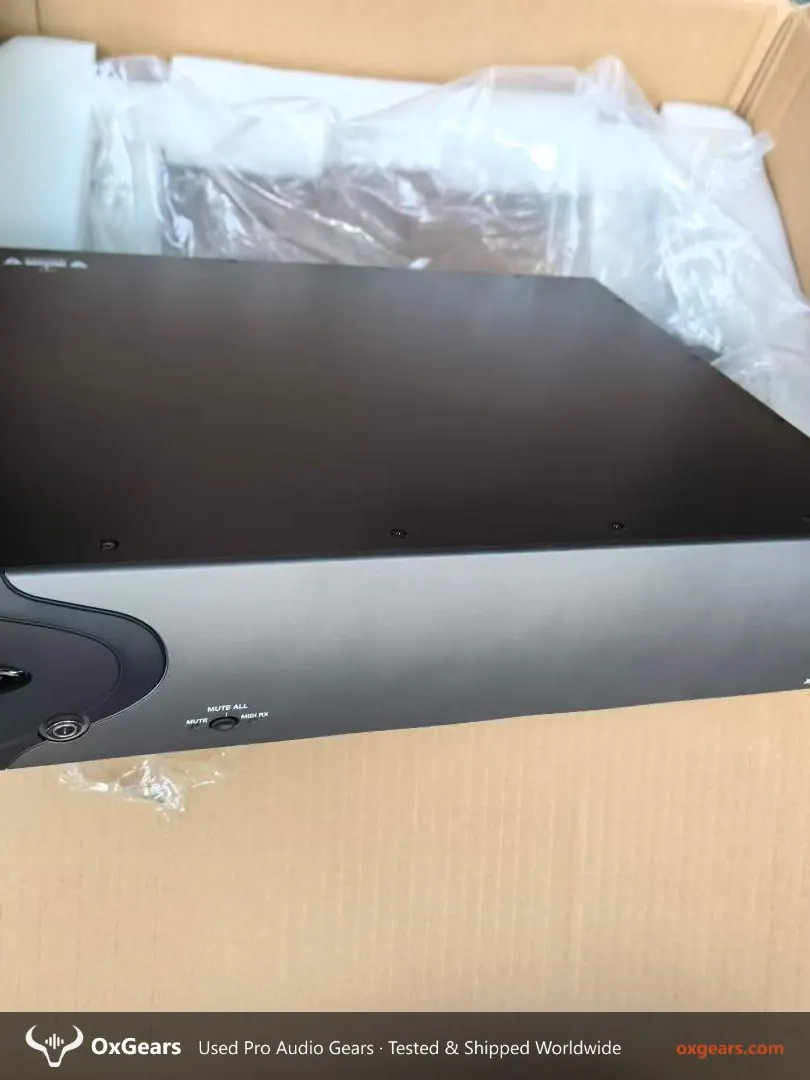
Next, confirm the control surface behaviour. The front panel provides MUTE ALL and MUTE, and MIDI RX allows remote control integration. Test that mute states latch and release cleanly, that MUTE ALL overrides individual mutes as expected, and that the MIDI RX path responds to the controller the studio actually uses. If you are buying remotely, request a short video showing mute toggling and MIDI response rather than relying on a written description. Buyers comparing options often search for a used Avid XMON for sale and then discover the condition details matter more than the listing photo.
Mechanical condition drives resale value in this category. The XMON is 19" × 1.75" × 13" (483 × 44 × 330 mm) and weighs 5.9 kg, so shipping damage usually shows as bent rack ears or a distorted chassis rather than internal failure. Check that the included rack ears are straight and that the front panel has no deep scratches across the labelling. Confirm the power cable is present and that the unit is rated 100–240 V AC, 50/60 Hz, which keeps it usable across Middle East, Southeast Asia, Africa, Europe and South America voltages without an external transformer.
Grade A means the unit should be fully functional with only light cosmetic wear. Ask for the test evidence behind that grade: audio pass-through on every input and output pair, mute logic verified, MIDI RX verified, and a photo set covering front, rear and rack ears. Rental companies should also confirm the unit has been rack-tested under load, since a controller that drops a monitor path mid-session is a liability on a client invoice. For teams building a full control room, pair this with the wider second hand studio recording equipment range rather than sourcing single units piecemeal.
Finally, plan the export paperwork and spares before ordering. Quantity available is on request, so confirm stock and request the serial and test record for the exact unit you will receive. Budget for a spare set of DB25 cables and label every connector on arrival so installers do not mispatch MAIN versus ALT paths. If you are outfitting a venue or integration project, review the used professional audio equipment catalogue to consolidate shipping and reduce per-unit freight cost. Treat the XMON as a monitoring backbone component: verify the connectors, the mute logic and the rack hardware, and a grade A unit will serve a control room for years.
Questions about this unit or about shipping to your country? Contact us for condition photos, test results and a quote.