Quick answer
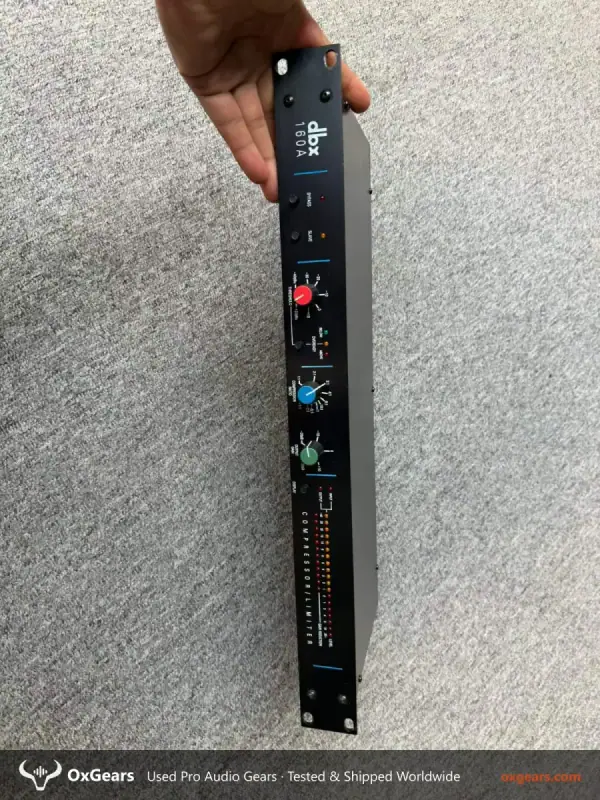
The used dbx 160A in this listing is a Grade A, single-channel, 1U unit with XLR in and XLR out, front-panel knobs and switches, 220–240 V AC and a listed weight of 2.3 kg. It is a plausible buy for a rental company or integrator that needs one channel of outboard dynamics in a rack and is willing to request a test before paying. It is not a documented, service-history-backed purchase: testing is on request and quantity available is on request, so the commercial terms are still open.
Key takeaways
1. The listing confirms one channel, 1U, XLR in/out, 220–240 V AC and 2.3 kg, and grades the unit A.
2. Test status is "on request" and quantity available is "on request", so nothing about function or stock is confirmed yet.
3. Serial history, service records and actual hours are not disclosed and must be asked for directly.
4. This is a single-channel box, so it solves one insert point, not a whole console's dynamics needs.
What the listing data says
The listing sits in the amplifiers-dsp category on OxGears, and the dbx 160A carries the fields a buyer can actually read: Channels 1; Power 12 W; DSP N/A; Inputs / outputs 1 x XLR in, 1 x XLR out; Network N/A; Control front-panel knobs and switches; Rack units 1; Weight 2.3 kg; Voltage 220–240 V AC; Tested on request; Quantity available on request. Condition grade is A.
Two things follow from that combination that a generic product page will not spell out. First, the unit is analogue in operation and analogue in patching: DSP is listed as N/A and network is N/A, so there is no remote control, no preset recall and no software layer to verify. Everything a buyer can check is physical — knobs, switches, XLR connectors, and whether the front panel responds as it should. Second, the 220–240 V AC rating is the field that decides which markets you can ship to. For buyers in the Middle East, Southeast Asia, Africa, Europe and South America, a unit wired for 220–240 V removes the step-down transformer question from the shipment, which matters more on a small 2.3 kg box than on a rack of amplifiers.
The 12 W figure is listed as power and should be read as the listing's own field, not as an amplifier output rating; this is a dynamics unit, not a power amplifier, so do not size a circuit around it. The 1U, 2.3 kg combination is the practical part: it ships cheaply, it fits a spare rack space, and it can be added to a mixed pallet of used amplifiers and DSP without changing freight class.
Grade A is the highest grade OxGears uses, and the site explains the scale in its article on how used professional audio is graded A, B and C. What the grade does not do is replace a test. A Grade A unit is a cosmetic and completeness judgement; the listing explicitly separates that from test status, which is "on request".
What the datasheet does not tell you
The listing is silent on serial history, service records, repair history, actual hours of use, and the cosmetic detail behind the A grade. It does not state which production era the unit comes from, whether the knobs and switches are original, or whether the XLR connectors have been replaced. It does not state whether a power cable is included, whether the unit ships in a flight case, a carton or neither, and it does not state quantity available beyond "on request".
Each of those gaps changes the decision in a specific way. Serial history tells you whether the unit is a single owner piece or has passed through several rental fleets, which is the difference between a predictable spare and an unknown. Service records tell you whether the unit has been opened, and by whom. Actual hours matter less on an analogue dynamics unit than on a console, but they still indicate whether it lived in a fixed install or on the road. Packaging condition decides your inbound freight risk and whether you can re-ship to your own customer without buying a case.
Test status is the biggest gap. "Tested: on request" means no test result exists in the listing. You cannot compare this unit against another on measured performance, and you cannot tell your own buyer that it was verified. That is not a reason to walk away; it is a reason to make the test a condition of the quote.
Who should not choose this
Do not choose this unit if you are equipping a console position that needs dynamics across many channels at once. One channel means one insert point; a rental house building a standard outboard rack will need several units or a different product, and buying one at a time to build a rack means repeating the same unknown-history conversation for each unit. Buyers who need a controllable processing unit instead of a knob-only analogue box can compare this against a used Adamson PLM 20K44 and request the same test confirmation before paying.
Do not choose it if your workflow depends on digital control, preset recall or networked device management. DSP is N/A and network is N/A on this listing, so any expectation of remote operation or software integration is misplaced.
Do not choose it if your procurement rules require documented service history or a published test report before payment. Nothing in the materials supports either, and "on request" is not a substitute for a document you can file.
Room and venue fit matters too. In a fixed install where the rack is closed and access is rare, a single-channel analogue unit with front-panel knobs is a poor choice because every adjustment means opening the rack; a venue that wants set-and-forget processing should look at a controllable unit instead. It is also a bad fit for a venue whose technical rider specifies a particular processing chain, because you cannot confirm from this listing that the unit matches a rider requirement.
Trade-offs to weigh
Grade A versus unverified function is the first trade-off. You are paying for a cosmetic and completeness judgement on a unit whose test status is still open. If the test comes back clean, the grade is a bonus; if you skip the test, the grade is doing work it was never meant to do.
Single channel versus rack economy is the second. A 1U, 2.3 kg unit is cheap to ship and easy to slot in, but one channel per 1U is a low density of processing per rack space. Buyers who count rack units against channel count will find this an expensive way to fill a rack; buyers who need exactly one insert point will find it efficient.
Analogue-only control versus modern expectations is the third. Front-panel knobs and switches with no DSP and no network means nothing to configure, nothing to update, and nothing to fail in software — but also no recall, no remote trim, and no way to lock settings against a curious operator. For a rental fleet that re-deploys gear weekly, that is a real operational cost. Integrators weighing this analogue unit for a fixed install can also review the used pro audio options for a worship sound system before committing to a single-channel box.
Voltage coverage versus local stock is the fourth. The 220–240 V AC rating makes this unit easy to move between your markets, which is a genuine advantage for an exporter's customer base across the Middle East, Southeast Asia, Africa, Europe and South America. The trade-off is that universal input says nothing about the condition of the internal supply, which is exactly the kind of thing a test should cover.
Finally, quantity on request versus planning. You cannot build a quotation to your own customer around a stock figure you do not have. Ask for the count before you commit to a delivery date.
Next step before you pay
Integrators building a banquet event PA system should confirm the test result before adding this single-channel unit to a rack, since the listing only offers testing on request.
Ask for availability and a quote for this specific unit through the OxGears contact page, and make the following part of the same message so the answer is usable: the serial number, any service or repair records, the result of the test offered on request, the quantity currently available, what is included in the box, and how the unit will be packed for export.
If you are comparing this against other outboard options, browse the used amplifiers and DSP in the same enquiry so freight can be consolidated. Buyers sourcing a full rack often pair a unit like this with second hand line array speakers and consoles from the same shipment; consolidating reduces per-unit freight and paperwork, and it means one test request covers the whole order.
Do not send payment against a listing alone. The materials give you a grade, a set of physical specifications and an offer to test. They do not give you a price, a warranty, a lead time or a minimum order quantity, and none of those should be assumed.
FAQ
Is this dbx 160A tested before I buy?
The listing states "Tested: on request", so no test result is published. You need to request the test and wait for the result before paying.
What condition grade is this unit?
It is graded A, the highest grade on the OxGears scale. The grade covers cosmetic and completeness judgement, not measured performance. Anyone weighing a second dbx unit against this one should read the used dbx D80 buying guide, which follows the same condition-note approach to serial history and test status.
Does it work on 220–240 V countries?
The listing gives the voltage as 220–240 V AC, so the unit suits 220–240 V markets; it is not a 100–240 V universal input, and 120 V countries need a step-up transformer.
How many channels and rack units?
One channel, 1U rack, with 1 x XLR in and 1 x XLR out, front-panel knobs and switches, and a listed weight of 2.3 kg.
How many units are available?
Quantity available is listed as "on request", so the stock figure must be confirmed with OxGears before you plan a shipment.
## Sources
OxGears listing: dbx 160A — /products/dbx-160a/
Manufacturer published specifications for dbx 160A — no verifiable URL supplied.
Comparing options or ready to price a unit? Request a quote with your destination country and quantity.