Quick answer
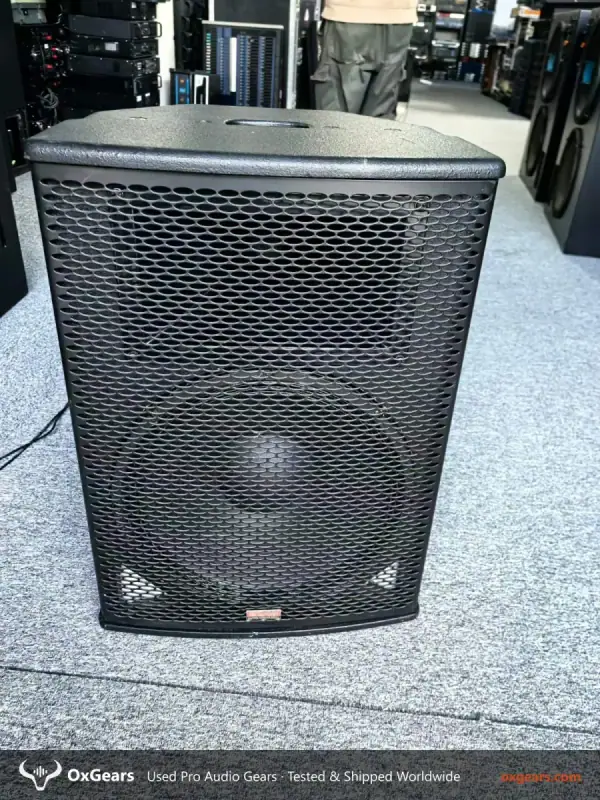
The used EAW JF56 is an 8 ohm, 800W two-way cabinet with a single 15-inch driver, 90 by 60 degree coverage and a 55 Hz to 18 kHz range, offered here at condition grade A. It suits rental companies, system integrators and venue owners who need a wide-pattern box for infill, side hang, delay and front fill work rather than deep subwoofer output. Ask OxGears for current availability and a quote before you build it into a system design.
Key takeaways
1. The 90 by 60 degree pattern is wide, so the JF56 covers a room laterally better than a narrow array element but throws less far.
2. At 55 Hz the cabinet reaches vocal and instrument fundamentals but not subwoofer territory, so plan separate subwoofers for music-heavy rooms.
3. Grade A tells you the cosmetic and functional baseline the seller claims, not a measured performance report, so inspection still matters.
4. Year of manufacture, quantity and price are not published, so the quote request is the first real step.
What the listing data says
The published specification is compact and usable. The JF56 carries one 15-inch driver, handles 800W, presents 8 ohms, and covers 55 Hz to 18 kHz with a maximum SPL figure of 129 dB. Coverage is stated as 90 degrees horizontal by 60 degrees vertical. Connections are two NL4 sockets, dimensions are 600 x 400 x 450 mm, and the unit weighs 28 kg. Condition grade is A. Year of manufacture and quantity available are both marked as on request.
Those numbers describe a box that is easy to move and easy to power. At 28 kg it is a one-person lift for most crew, which matters for rental stock that gets loaded and unloaded repeatedly. Two NL4 connectors mean you can daisy-chain cabinets on a single run, which simplifies wiring on delay and fill positions. 8 ohms is a friendly load for most amplifiers, letting you put more cabinets on one channel than a 4 ohm design would allow, though the exact count depends on the amplifier's rating rather than the cabinet alone.
The 800W power handling figure is the number to quote to your amplifier supplier, not a promise about acoustic output. The 129 dB maximum SPL figure is a specification value, and how close a used unit gets to it depends on driver condition, which the listing does not measure. If you are assembling a mixed inventory of used pro audio equipment for rental, the JF56's impedance and connector choices make it one of the easier cabinets to slot into an existing amp rack.
What the datasheet does not tell you
A specification sheet describes a new cabinet. It does not describe the specific units in this listing. The gap between the two is where used buying decisions are actually made.
The first unknown is year of manufacture, listed as on request. Age matters because loudspeaker surrounds, adhesives and cone materials change over time, and a cabinet that has spent a decade in a touring truck has a different wear profile from one that lived in a fixed install. Ask for the year on each unit, not a general answer.
The second unknown is quantity available, also on request. For a distributor or a rental house, quantity drives the decision as much as condition does. Two cabinets support a small fill position. Eight cabinets support a proper distributed system. You cannot plan an array or a multi-room install without knowing the count, so treat this as a first-order question rather than a detail.
The third unknown is driver history. The listing does not state whether the 15-inch drivers are original, re-coned, or replaced with aftermarket parts. A re-cone is not automatically a problem, but it changes the value and the sound, and it is the single most common reason a used cabinet's price moves. Ask directly and ask for photographs of the cone, surround and spider.
The fourth unknown is test evidence. There is no published impedance sweep, no SPL measurement and no sweep test result. Grade A is a grading claim about cosmetic and functional condition, and the general approach to grades is worth reading in how used professional audio is graded before you rely on a letter. For a cabinet at this level, a simple impedance check and a listen test at the seller's facility, or an agreed inspection protocol, closes most of the gap.
The fifth unknown is commercial: no price, no warranty period, no lead time and no MOQ appear in the materials. Those are quote items, not page items. Do not assume any of them.
Who should not choose this
Do not choose the JF56 if your room needs subwoofer output. The cabinet's range starts at 55 Hz, which is respectable for a 15-inch two-way but does not replace a dedicated subwoofer for dance music, live drums or any application where the low end is the product. If your system design calls for 35 Hz or below, this is the wrong box and you will end up buying subwoofers anyway.
Do not choose it if you need long-throw main array coverage. A 90 by 60 degree pattern is wide, and wide patterns trade distance for spread. For a large venue where the main hang must reach the back of a deep room with controlled vertical coverage, a line array element is the correct tool, and the used line array buying checklist is a better starting point than a single wide-pattern cabinet.
Do not choose it if your procurement process requires published test data, a stated warranty period or a fixed lead time before approval. None of those appear in the materials, and if your buyer cannot proceed without them, this listing will stall.
Do not choose it if you need a confirmed multi-cabinet quantity today. Quantity is on request, so a project that depends on a specific count should confirm that count before design work begins.
Trade-offs to weigh
Wide coverage against throw. The 90 by 60 degree pattern is genuinely useful for front fill, lip fill, delay positions and rooms where the audience is spread laterally rather than deep. The same pattern puts energy on side walls in a narrow room, which can raise reflections. Match the pattern to the room before you commit to a number of cabinets.
Weight against output. At 28 kg the cabinet is manageable for one person and cheap to ship relative to larger boxes. The trade-off is that a single 15-inch two-way has a finite output ceiling, and the 129 dB specification figure is a maximum, not a working level. For speech, playback and moderate music levels in a mid-sized room, the cabinet is comfortable. For high-SPL music in a large room, you will need more boxes, which brings you back to the quantity question.
Grade A against verification. A Grade A unit should arrive without major cosmetic damage and in working order, which reduces the refurbishment budget you need to carry. The trade-off is that grade does not replace a driver inspection. Budget a small allowance for a re-cone or a connector replacement on any used cabinet, and treat a clean inspection as a saving rather than a plan.
Connector simplicity against amplifier choice. Two NL4 sockets and an 8 ohm load make wiring straightforward, but the amplifier still has to be chosen for the 800W handling figure and the number of cabinets per channel. Confirm the amp match with your supplier rather than assuming a single model fits every channel count.
Next step before you pay
Start with the quote request. Use the OxGears contact route to ask for the year of manufacture, the quantity currently available, the condition notes on each unit, and the commercial terms that apply to your destination. Ask specifically whether the 15-inch drivers are original or re-coned, and request photographs of the cone, surround, basket and both NL4 connectors.
Then run the inspection plan. For a used cabinet, the practical checks are a visual pass on the cone and surround, a gentle push test on the cone for voice coil rub, an impedance reading on each unit to confirm it sits near the nominal 8 ohm figure, and a listen test at moderate level on both connectors. If you are buying remotely, agree in writing which of these checks the seller will perform and record before shipment, and ask for the results with the invoice.
Finally, plan the system around the cabinet rather than the other way round. Confirm amplifier compatibility with the 800W and 8 ohm figures, confirm whether subwoofers are needed for your program material, and confirm the cabinet count against the room. If you are building a broader inventory, browse the wider second hand line array speakers and related stock alongside this model so the system design is coherent before you commit budget.
FAQ
What are the EAW JF56's key specifications?
One 15-inch driver, 800W power handling, 8 ohm impedance, 55 Hz to 18 kHz frequency range, 129 dB maximum SPL, 90 by 60 degree coverage, two NL4 connectors, 600 x 400 x 450 mm and 28 kg.
What condition grade is this used EAW JF56?
The listing states condition grade A.
Does the listing state the year of manufacture and quantity?
No. Both year of manufacture and quantity available are marked as on request.
Can the EAW JF56 replace a subwoofer?
Its range starts at 55 Hz, so it covers vocal and instrument fundamentals but not subwoofer territory; plan separate subwoofers where deep low frequency is required. Rental companies building a mixed inventory of used pro audio equipment should confirm the JF56's 8 ohm load and NL4 wiring against their existing amp racks before committing to a cabinet count.
Is a price, warranty or lead time published?
No price, warranty period, lead time or MOQ appears in the listing materials; these need to be requested in a quote.
## Sources
EAW JF56 product page: /products/eaw-jf56/
OxGears products: /products/
OxGears contact: /contact/
Manufacturer published specifications for EAW JF56 (no verifiable link supplied).
Need condition photos or test results before you commit? Contact our team and we reply within one working day.