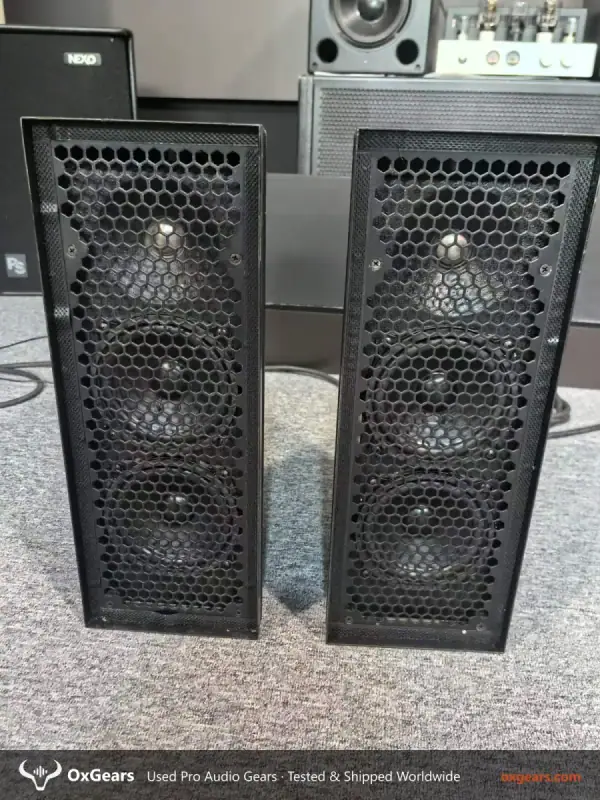
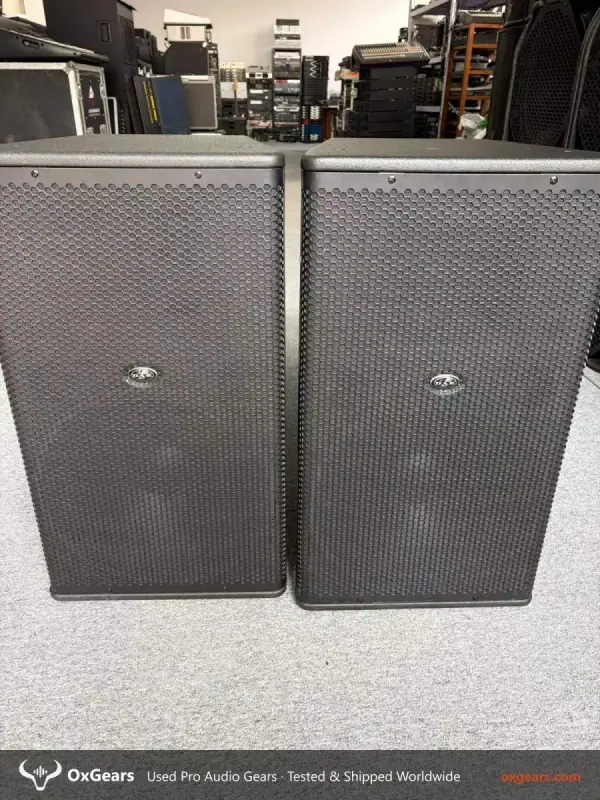
The Meyer Sound UPM-1P is a compact self-powered two-way cabinet, and the OxGears listing offers two units at condition grade A. Read the listing as a starting point for inspection, not as a finished assessment: the published data covers drivers, coverage, dimensions and connectors, while year of manufacture, price and service history stay off the page. Buyers should confirm availability and request the missing unit-level details before committing.
Quick answer
The listing describes two Meyer Sound UPM-1P cabinets graded A, each with 2 × 5" LF drivers and a 1" HF dome, 75 Hz – 20 kHz frequency range, 118.5 dB max SPL, 100° × 100° coverage and a self-powered design fed by XLR 3-pin input with loop and PowerCON AC. Grade A is the strongest condition band OxGears publishes, but it is a cosmetic and functional grading, not a substitute for a bench check of the amplifier module. Ask OxGears for availability and a quote on the pair, then run the inspection points below.
Key takeaways
1. The UPM-1P is self-powered, so power handling is listed as N/A and the amplifier module — not the drivers — is the main risk item to inspect.
2. Coverage of 100° H × 100° V is wide and symmetrical, which suits distributed fill and near-field monitoring more than long-throw array work.
3. Only two units are available, so this is a small-lot purchase rather than a batch buy for a rental fleet.
4. Year of manufacture, price, lead time and warranty are not disclosed and must be requested before you compare this against other used pro audio equipment.
What the listing data says
The published specification block is complete enough to place the cabinet in a system. Two 5" low-frequency drivers and a 1" high-frequency dome give a two-way active design covering 75 Hz to 20 kHz, with maximum SPL stated at 118.5 dB. Nominal impedance is given as 8 Ω, and power handling is marked N/A because the cabinet is self-powered — a detail worth reading carefully, since it tells you the unit carries its own amplification and therefore its own AC and thermal considerations.
Coverage is 100° horizontal by 100° vertical, which is unusually wide in both planes for a compact box. Physical data is 176 × 457 × 193 mm at 9.98 kg, so a single person can handle a unit, and the shallow 193 mm depth helps in tight install positions. Connections are an XLR 3-pin input with a loop output plus PowerCON AC, which is a standard pro-audio interface set and means the cabinets can be daisy-chained on the signal side.
Condition grade is A. OxGears publishes a grading scale, and the meaning of that band is set out in how used professional audio is graded — read it before you treat grade A as a guarantee of anything beyond the published criteria. Year of manufacture is available on request, and quantity available is two.
What the datasheet does not tell you
A specification block describes a design, not a specific pair of cabinets. Several things that matter for a buying decision are simply not on the page.
Year of manufacture is the first gap. It is listed as available on request, which means you cannot infer driver age, capacitor age or amplifier revision from the listing. For a self-powered cabinet, the amplifier module is the component most likely to need service, and its age and service history are undocumented here.
Price, MOQ, lead time and warranty are all absent. None of these can be assumed, and none should be inferred from the grade. If your purchasing process requires a warranty term or a fixed lead time before you raise a PO, that has to come from a direct exchange, not from the listing. Buyers weighing this compact box against other used PA speakers should apply the same diligence to the amplifier module, connectors and documented history before committing to a purchase.
There are no test results, no frequency response sweep, no SPL verification and no photos of the individual units in the published data. Serial numbers are not shown. That matters because a two-unit lot is small enough that unit-to-unit variation is the whole purchase: you are buying these two cabinets, not the model.
Finally, the 8 Ω impedance figure is a nominal rating in an active cabinet and should not be read as a passive load specification. It does not tell you how the cabinet behaves on a given AC supply, which is a practical question for venues in markets with unstable mains.
Who should not choose this
Do not choose this pair if you need low-frequency weight. A 75 Hz lower limit and 5" LF drivers place the UPM-1P firmly in speech, fill and light-music territory; a venue owner expecting subwoofer support from the main cabinets will be disappointed and will need separate subwoofers.
Do not choose it if you are building a line array or a matched multi-box hang. Two units at 100° × 100° coverage are a distributed fill or near-field solution, not an array element. Buyers shopping for array scale should look at second hand line array speakers instead.
Do not choose it if your procurement requires published warranty terms, a stated lead time or documented test data before payment. None of that is on the listing, and a two-unit lot rarely justifies a long qualification cycle unless the application is well defined.
Do not choose it if you need a large matched quantity from one batch. Quantity available is two, full stop.
Trade-offs to weigh
Self-powered versus passive is the central trade-off. You avoid amplifier racks and speaker cable runs, and the XLR loop lets you chain signal between cabinets. In exchange, every cabinet needs AC at its position, the PowerCON inlet and internal module become wear items, and service means dealing with amplification inside the box rather than swapping a rack amp. For fixed installs with power at each position this is a clean win; for touring racks it is a logistics decision.
Wide coverage versus throw is the second. A 100° × 100° pattern covers a broad area from a short distance, which is efficient for fill and delay positions and for rooms with low ceilings. The same pattern puts energy where you may not want it in a reverberant hall, and it does not give you the directional control of a horn-loaded array element.
Grade A versus documented history is the third. Grade A tells you the unit passed OxGears' condition criteria; it does not tell you the amplifier module's service record. Weigh the grade as a filter, then spend your diligence on the specific questions in the next section. If you are comparing this against other compact boxes, the same logic applies across the used pro audio catalogue. For a banquet hall or similar low-ceiling room, the wide 100° × 100° pattern and compact 193 mm depth make distributed fill positions easier to plan than a long-throw array element would.
Next step before you pay
Ask OxGears for availability and a quote on the two units through contact OxGears, and put these questions in the same message so the reply is usable in one pass. Requesting the missing unit-level details is the same discipline that pays off when comparing this pair against other used pro audio equipment on the market.
Request the year of manufacture for both units. Ask for photographs of the actual cabinets, including the rear panel, the PowerCON inlet, the XLR connectors and the driver faces. Ask whether the amplifier modules have been serviced and whether any fault history is known. Ask for a bench confirmation that both cabinets power up and pass signal on the XLR input and loop. Ask for the serial numbers so you can record them on the commercial invoice.
On the commercial side, confirm the Incoterm you are quoting against — FOB is the usual starting point for export buyers — along with packing details for the pair, since 9.98 kg per cabinet and a 457 mm width make single-carton or paired-carton shipping a real choice. Confirm the destination port and who handles export documentation. None of these values are published, so treat every one as a question rather than an assumption.
If the answers line up with your application, the pair is a straightforward small-lot purchase. If the year of manufacture comes back late in the product's life or the module history is unknown, price the risk of a service event into your offer rather than assuming grade A removes it.
FAQ
How many Meyer Sound UPM-1P units are available?
The listing states a quantity available of two.
What condition grade are the listed UPM-1P cabinets?
They are graded A, the condition band described in OxGears' grading explanation.
Is the UPM-1P passive or self-powered?
It is self-powered; the listing marks power handling as N/A and specifies a PowerCON AC connector plus XLR 3-pin input with loop.
What coverage pattern does the UPM-1P have?
100° horizontal by 100° vertical, per the listing specification.
Does the listing state price, warranty or lead time?
No. Price, warranty, lead time and MOQ are not disclosed on the listing and must be requested directly.
## Sources
Meyer Sound UPM-1P listing on OxGears: /products/meyer-sound-upm-1p/
OxGears used pro audio catalogue: /products/
OxGears contact: /contact/
Manufacturer published specifications for Meyer Sound UPM-1P.
Want to confirm stock, shipping cost or lead time? Ask about availability and we will check the unit for you.