Quick answer
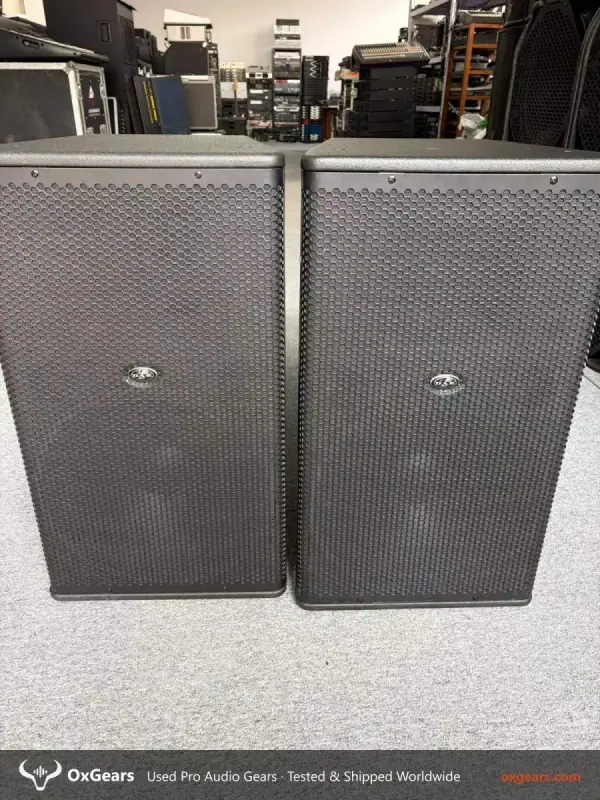
The used Outline EIDOS15 in this listing is a Grade A two-way cabinet with a 15-inch LF driver and an HF horn, rated 400 W Pmax, 7.3 Ohm and 126 dB max SPL, covering 90 by 60 degrees. It is worth buying if you need a compact point-source box for rental or install work and you can confirm driver originality and impedance before payment. It is not a long-throw line array substitute, and the listing leaves year of manufacture, quantity and service history open.
Key takeaways
1. The 7.3 Ohm nominal impedance and 400 W Pmax mean you should plan amplifier channels around this cabinet rather than assume a standard 8 Ohm load.
2. Grade A describes cosmetic and functional condition, not driver history, so ask for photos of the LF cone, HF diaphragm and rear connector plate.
3. The 90 by 60 degree pattern suits medium rooms and monitor-style fills better than wide, deep halls.
4. Year of manufacture, quantity available, price and lead time are all Unknown / Not disclosed in the listing, so availability must be confirmed directly.
What the listing data says
The listing describes an Outline EIDOS15 speaker in condition grade A. The published specs are: one 15-inch LF driver plus one HF horn; 400 W Pmax power handling; frequency range 55 Hz to 20 kHz; maximum SPL 126 dB; impedance 7.3 Ohm; coverage 90 degrees horizontal by 60 degrees vertical; NL4 connector wired 1+1-; dimensions 540 by 340 by 320 mm; weight 25.8 kg. Year of manufacture and quantity available are both marked on request.
Two things in that combination matter more than the headline numbers. First, 7.3 Ohm is not a round 8 Ohm figure. Amplifier channel planning, parallel cabinet counts and DSP preset selection should be checked against the real load rather than assumed, because two cabinets in parallel land near 3.65 Ohm, which changes how hard a given amplifier works. Second, 400 W Pmax with 126 dB max SPL tells you this is a moderate-power box, not a high-output sub-bass cabinet; the 55 Hz low-frequency limit confirms it is a full-range top or fill cabinet rather than something you would deploy alone for dance-floor low end. Rental companies weighing this cabinet against a banquet event PA system setup should remember that the 90 by 60 degree pattern and 25.8 kg weight suit medium rooms and fast load-in better than deep halls.
The 25.8 kg weight and 540 by 340 by 320 mm footprint make it a one-person lift for most crew, which matters for rental companies counting labour on load-in. The NL4 1+1- wiring is the common convention, so cabling is not a barrier, but confirm the connector plate has not been rewired.
If you are comparing this against other compact two-way boxes, the second hand line array speakers category page shows what else is moving through stock, and the full used Outline EIDOS15 for sale page carries the current listing detail.
What the datasheet does not tell you
A spec sheet describes a new cabinet. This is a used one, and the gap between the two is where the money sits.
Year of manufacture is listed as on request. That single missing value changes the risk profile: an early-production cabinet may have had more venue hours and more driver swaps than a recent one, and Outline has revised products over time. Without a manufacture year you cannot judge age-related wear on the HF diaphragm, the cone surround or the crossover components.
Serial history and service records are not disclosed. You do not know whether the LF driver is original, re-coned, or replaced with a non-original part. A re-cone is not automatically bad, but it affects value and it affects how closely the cabinet matches its siblings in a pair or array. If you are buying several units, mismatched drivers between cabinets are a real problem for tonal consistency.
Actual hours of use are not disclosed. Grade A tells you the unit presents well and functions, but it does not tell you whether it spent five years in a dry install or two seasons on the road in a humid climate.
Flight-case or packaging condition is not disclosed. For export buyers this matters directly: a cabinet shipped without a proper case or crate is exposed to handling damage, and the cost of crating falls on someone.
Price, warranty, lead time and MOQ are all Unknown / Not disclosed. Do not plan a budget around assumptions here; ask.
Who should not choose this
Do not choose this cabinet if your application is a large hall, an outdoor stage or a long-throw main system. A single 15-inch two-way with 126 dB max SPL and 90 by 60 coverage is a point-source box; it will not deliver the pattern control or the throw that a line array provides over distance. Buyers who need that should be looking at a used line array system, not this.
Do not choose it if you need confirmed low-frequency extension below 55 Hz for music-heavy venues without subwoofers. This cabinet is not a subwoofer and should not be deployed as one.
Do not choose it if you are buying sight-unseen for a client install where driver originality is contractually required and the seller will not provide photos or documentation. The listing does not disclose serial history or service records, and if the seller will not close that gap, the risk stays with you.
Do not choose it if you need a matched, documented pair or a multi-cabinet array with verified identical driver history. Quantity available is on request, and matching cannot be assumed.
Trade-offs to weigh
The obvious trade-off is output versus portability. At 25.8 kg and 400 W Pmax, this is a cabinet you can move and deploy quickly, but 126 dB max SPL caps how much room it can cover. For a rental company, that is often the right trade: fast load-in and flexible placement beat raw output on corporate and medium-room work. For a venue owner planning a fixed install in a deep room, the same numbers become a limitation.
The second trade-off is impedance planning versus amplifier inventory. Because the cabinet is 7.3 Ohm rather than 8 Ohm, the number of cabinets you can safely parallel per amplifier channel may differ from what your existing amp plan assumes. That is not a defect, but it is a planning constraint that shows up at commissioning, not at purchase. Check your amplifier's rated load before you commit to a quantity.
The third trade-off is grade versus history. Grade A is a useful filter, but it is a condition grade, not a provenance document. You are trading a lower price for less certainty about driver history, manufacture year and hours. Whether that is a good trade depends entirely on what the seller will show you before payment.
Finally, coverage. The 90 by 60 degree pattern is forgiving for medium rooms and monitor use, but in a wide, shallow room it may spill more than you want, and in a narrow, deep room it may not reach the back. Match the pattern to the room before you match the price to your budget.
Next step before you pay
Ask for availability and a quote for this specific unit through the OxGears contact page, and put the following on the request: year of manufacture, quantity available, price, lead time and whether any warranty is offered. All of those are Unknown / Not disclosed in the listing, so they must come from the seller.
Then ask for evidence before money moves. Request clear photos of the LF cone front and back, the HF horn and diaphragm area, the rear connector plate and the cabinet corners and grille. Ask directly whether the LF driver is original or re-coned, and whether the cabinet has been serviced. Ask for the serial number so you can record it on the invoice.
For export orders, confirm how the unit will be packed or crated, and confirm the shipping terms in writing. If you are buying more than one, ask whether the units can be matched by driver type and condition. Buyers still comparing options can browse the used pro audio speakers range to see how this compact two-way box sits against other stock.
Finally, test on arrival. Check impedance with a meter before connecting to amplifiers, sweep the cabinet at low level to listen for rub, buzz or diaphragm noise, and inspect the NL4 connector for correct 1+1- wiring. If anything does not match the listing, raise it immediately rather than after the unit goes into service.
FAQ
What condition is this used Outline EIDOS15 in?
The listing grades it A. Grade A is a condition grade covering cosmetic and functional presentation; it does not document driver history or hours of use.
What are the power handling and impedance of the EIDOS15?
The listing states 400 W Pmax and 7.3 Ohm impedance, with 126 dB max SPL and a 55 Hz to 20 kHz frequency range.
How many EIDOS15 cabinets are available?
Quantity available is listed as on request, so it is not disclosed in the listing and must be confirmed with the seller.
What coverage pattern does it provide?
90 degrees horizontal by 60 degrees vertical, per the listing specs.
Is a price or warranty included?
No. Price, warranty, lead time and MOQ are not disclosed in the listing and must be requested directly.
## Sources
OxGears listing: Outline EIDOS15 — /products/outline-eidos15/
Manufacturer published specifications for Outline EIDOS15 — no verifiable URL supplied. Buyers still comparing options can browse the used pro audio speakers range to see how this compact two-way box sits against other stock.
Shipping several units or building a full system? Check shipping options with your port and timeline.