Used Line Array Speakers for Sale in Nigeria: B2B Buying Guide
Navigate the purchase of used line array speakers in Nigeria with our B2B guide. Learn what to check, what data is missing, and how to avoid pitfalls.
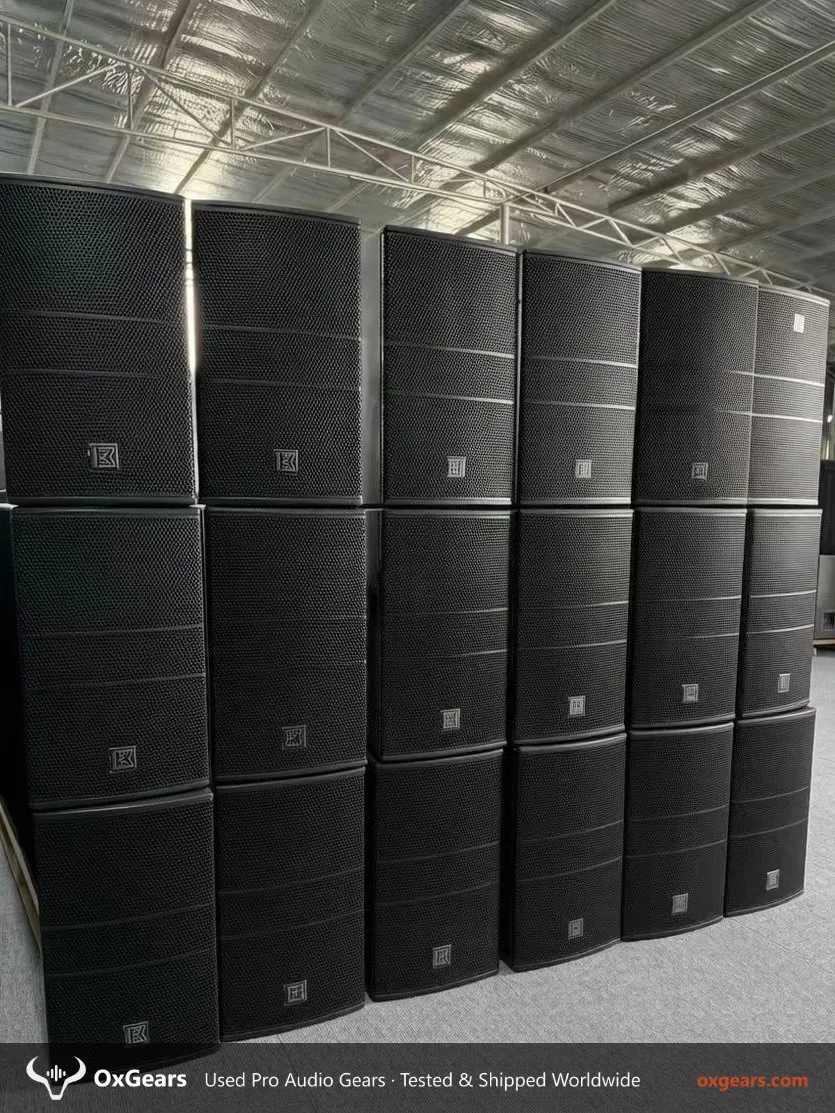
Bulk used PA speakers are bought as a matched inventory problem, not as a shopping-cart quantity. The right approach is to define the cabinet types and quantities you need, ask the exporter what can be grouped into coherent sets from current stock, and confirm grading, driver condition and packing before any deposit. OxGears publishes no fixed bulk price list, MOQ or lead time for this category, so every one of those values has to come from a direct availability request.
You buy used PA speakers in bulk by specifying the cabinet type, quantity and matching requirement first, then asking the exporter which units in stock can be grouped into identical or near-identical sets. Price, MOQ, lead time and warranty are not published for this category and must be confirmed per enquiry. The decision that actually determines whether the order works is how much grade variance you can absorb and how you will test and match cabinets on arrival.
1. Bulk value comes from matching, so ask for cabinets grouped by type and condition rather than a raw count. 2. Published prices, MOQ, lead times and warranty terms do not exist for this category and must be quoted per enquiry. 3. Grade mix inside a lot is the main unknown and should be agreed in writing before payment. 4. Plan driver and horn testing capacity before the container arrives, not after.
There is no listing data behind this topic. No model-specific figures, quantities, prices or condition notes can be cited here, and any article that quotes them for a bulk used speaker offer without a live stock sheet is inventing them. What can be said is structural: OxGears exports second-hand professional audio, and speakers sit alongside line arrays, subwoofers, full-range cabinets, amplifiers, consoles, microphones, DJ equipment and DSP in the same export flow. That matters because a bulk speaker order is usually placed by the same buyer who is also filling gaps in amplification and processing, and consolidating those lines into one shipment is where freight economics improve.
For the product families available, start from the OxGears pro audio department and the used speakers category, which is where full-range and subwoofer cabinets are grouped. If you want to see how individual units are presented before you scale up to a pallet, the full used equipment catalogue shows the format OxGears uses for single items, and two examples of that format are the JBL EON1500 listing and the Martin Audio A55 listing. Neither page should be read as a bulk stock statement; they show presentation style, not availability volume.
The honest summary is: the listing data says nothing about bulk quantities. Everything specific is Unknown / Not disclosed until you ask.
A specification sheet for any speaker model describes a new unit. It says nothing about the four things that decide the value of a second-hand cabinet: whether the drivers are original, whether they have been re-coned, whether the cabinet has been dropped or water-damaged, and whether the pair you receive is actually a pair. None of these appear in manufacturer documentation, and none of them can be confirmed from a stock photo.
For bulk orders the gap widens. A datasheet describes one cabinet; a bulk lot is a population. The population has a distribution of condition, and that distribution is the product. Two lots of the same cabinet count can be worth very different amounts because one contains eight matching units and the other contains eight units in four variants. Ask explicitly how many identical units exist, not how many units exist.
Other unknowns that matter and are Not disclosed for this category: export packing standard and pallet configuration, whether grilles and hardware are complete, whether handles and rigging points are intact, whether impedance and power handling have been verified per unit, and whether any units have been re-coned with non-original parts. Each of these changes either the resale value in your market or the labour cost of getting the lot saleable.
Do not choose bulk used PA speakers if your project requires every cabinet to be identical and documented. A fixed install with a published equipment schedule, a tender that names a specification, or a venue where a mismatched spare would be visible to the client are all bad fits. In those cases the variance inside a used lot becomes a liability you cannot sell on.
Do not choose this if you have no bench capacity. Bulk used speakers need driver sweeps, impedance checks, rub-and-rattle listening and a cosmetic sort before they go into rental stock or onto a resale list. A buyer without a technician and a test space will end up storing a pallet instead of selling it.
Do not choose this if you need a warranty position you can pass to your own customer. Warranty terms for this category are Not disclosed, so any downstream promise you make is yours alone to carry.
Do not choose this if you are buying for a single premium venue where the cabinets will be seen and touched. Cosmetic grade variance is inherent to second-hand stock and cannot be negotiated away in bulk.
Matching versus volume. Accepting a mixed lot gets you more cabinets per shipment; insisting on matched sets gets you a smaller, cleaner order. For rental companies the matched set usually wins because a mismatched cabinet becomes a spare nobody books. For distributors reselling to system integrators, volume with a clear grade breakdown can work if the grade is documented.
Price versus inspection cost. A cheaper lot with unknown driver history shifts cost from the invoice to your workshop. Re-coning, replacing horns and refinishing cabinets are real labour lines, and they land after the goods arrive, when you have less leverage.
Consolidation versus speed. Combining speakers with amplifiers, consoles and DSP in one shipment improves freight economics but ties the whole order to the slowest line. If your market needs cabinets first, splitting the order may be worth the extra freight.
Grade tolerance versus market. Buyers in some markets resell on cosmetic condition and buyers in others resell on function. Decide which market you are serving before you agree a grade mix, because the same lot is a good buy for one and a poor buy for the other.
Spares versus sets. A bulk lot with a few extra cabinets of the same type is useful as a spares pool. A bulk lot with a few cabinets of a different type is dead stock. Ask which one you are being offered.
Write a short specification before you contact anyone: cabinet type, intended use, quantity range, whether matched sets are required, and the grade floor you can accept. Send it as a request rather than browsing, because the answer depends on current stock and stock changes.
Use the OxGears contact page for availability and a quote to ask four things in one message: which cabinet types are currently available in quantity, how many identical units can be grouped per type, what the grade mix is per group, and how the lot is packed for export. Ask for a per-unit condition note rather than a single lot description, and ask for photographs of the actual units, including driver fronts and cabinet corners.
Before payment, agree in writing what happens if a unit fails your incoming test. Since warranty terms for this category are Not disclosed, the practical protection is a documented condition description that you can hold the shipment against. Keep the agreed description, the photographs and the packing specification together as one record.
Finally, plan the arrival. Book bench time, have replacement drivers or horns identified in advance where possible, and decide the sort order — functional test first, cosmetic grading second, matching third. A bulk speaker order is only as good as the sorting process behind it.
MOQ is Not disclosed for this category. OxGears does not publish a bulk MOQ, so the quantity threshold has to be confirmed per enquiry through the contact page.
Whether matched sets can be assembled from current stock is Unknown / Not disclosed. Ask specifically how many identical units exist per cabinet type, because a unit count and a matched-set count are different numbers.
No. Prices, lead times and warranty terms are not published for this category and must be quoted per enquiry against current stock.
Grade mix inside a bulk lot is Not disclosed. Ask for a per-unit condition note and photographs of the actual units, including driver fronts and cabinet corners, rather than a single lot description.
Export packing standard and pallet configuration are Not disclosed for this category. Confirm the packing specification in writing before payment so the shipment can be checked against it. ## Sources
OxGears pro audio department — /pro-audio/
OxGears speakers category — /pro-audio/speakers/
OxGears full used equipment catalogue — /products/
OxGears contact — availability and quote request — /contact/
No manufacturer specification is cited in this article because no model-specific figures are used. All quantities, prices, lead times, MOQ and warranty terms for bulk used PA speakers are Unknown / Not disclosed.
Navigate the purchase of used line array speakers in Nigeria with our B2B guide. Learn what to check, what data is missing, and how to avoid pitfalls.
How overseas distributors and rental companies should evaluate used line array speakers for sale in South Africa: grading, driver checks, rigging history and export steps.
How rental companies and distributors should source used line array speakers wholesale: what to verify, what stays undisclosed, and when to walk away.